If you’ve ever looked into Chinese martial arts, you’ve probably come across three categories: kung fu, tai chi, and qigong. They’re often mentioned together, sometimes used interchangeably, and regularly misunderstood. Are they the same thing? Are they related? Can you do one without the others?
The short answer is that they’re distinct arts with deep roots in the same tradition. Understanding what makes each one different is actually the best way to figure out which one, or which combination, is right for you.
Kung fu: the external art
Kung fu is what most people picture when they think of Chinese martial arts. Strikes, kicks, forms, sparring, weapons. It’s dynamic, physical, and built around combat effectiveness.
But interestingly, the term ‘kung fu’ actually means ‘skill developed through hard work and time.’ It’s a complete system that trains the body and the mind together, and the values embedded in its practice, respect, discipline, integrity, are just as central to the art as the techniques themselves.
The style taught at this academy is Buk Sing Choy Lay Fut, a Southern Chinese system known for its explosive power, fast angular strikes, and continuous pressure. It’s an art with a battlefield lineage, developed for real-world effectiveness and passed down through a direct chain of masters that stretches back generations.
Training in kung fu builds strength, coordination, and practical self-defence skills. It also builds something harder to measure: a sharpness and presence that comes from training under real pressure over time.
Tai chi: the internal art
Tai chi is often seen as the gentle, slow-moving practice you might spot in a park on a Sunday morning. That’s not wrong, but it’s only part of the picture.
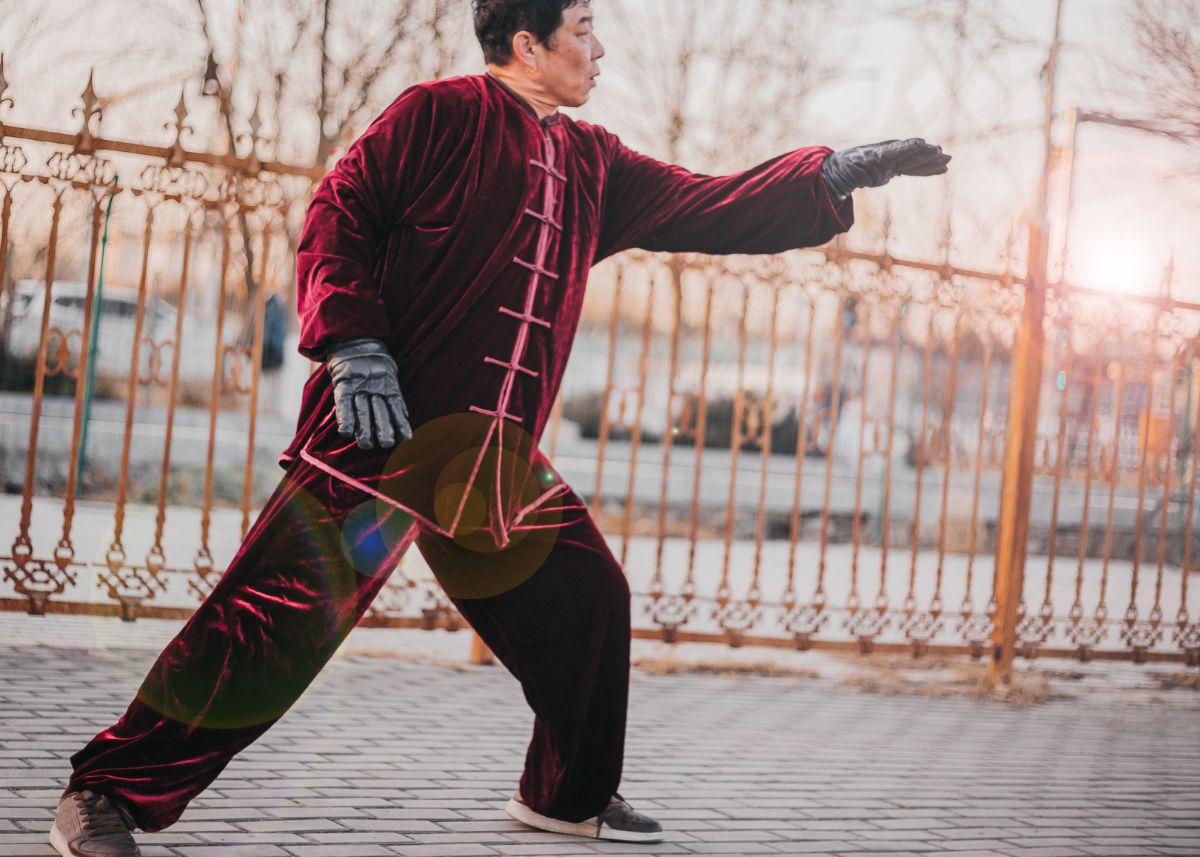
Chen Tai Chi, the style taught here, is the oldest and most dynamic form of Tai Chi. It comes from Chen Village in China and is very different from the slow, purely meditative versions many people are familiar with. Chen Tai Chi combines flowing, graceful movement with explosive bursts of power called ‘fajin.’ It is an internal martial art, meaning it develops power from the inside out, through the cultivation of structure, breath, and what practitioners call internal energy.
The practice strengthens the joints, improves posture and balance, and develops a kind of full-body coordination that’s difficult to replicate through conventional exercise. It also has a profound settling effect on the nervous system. Students who come to Chen Tai Chi feeling stressed, scattered, or depleted often describe it as the first thing that has genuinely helped them slow down and reconnect with their bodies.
It’s worth knowing that tai chi and kung fu aren’t opposites. Historically, tai chi is a martial art in its own right. The softness in its movement is a training method, not a limitation. Many serious kung fu practitioners also train tai chi, and the two complement each other deeply.
Qigong: the foundational practice
Qigong is perhaps the least well-known of the three in the West, but it may be the most accessible entry point of all.
‘Qi’ refers to life energy or vital force, and ‘gong’ means cultivation or work. Qigong is essentially the practice of working with the body’s energy through precise movement, breathing, and focused awareness. It has been practised for thousands of years, originally within the Shaolin Temple, and its roots in Chinese medicine and martial arts run very deep.
There are two qigong systems taught at this academy. Lohan Qigong is the older of the two, a closely guarded system of the Shaolin Temple once believed to give monks extraordinary strength and resilience. It is calming, deeply restorative, and works by activating and circulating energy through the body’s main channels. Sinew Qigong, by contrast, is more physically vigorous. It strengthens the tendons, builds internal power, and forges the kind of structural integrity that supports both martial training and long-term health.
You don’t need to be a martial artist to benefit from qigong. It suits people of any age or fitness level, and it’s particularly valuable for those recovering from burnout, injury, or chronic stress.
How they relate to each other
Think of it this way. Kung fu is the external expression, the striking, the forms, the fighting application. Tai chi is the internal complement, developing power, sensitivity, and calm from within. Qigong is the foundation beneath both, building the energy, structure, and body awareness that everything else draws from.
In a traditional training environment, these three arts aren’t really separate. A serious kung fu practitioner will often train tai chi to develop internal power, and qigong to maintain their health and energy over a lifetime. The arts inform each other, and training across all three creates something more complete than any one of them alone.
Which one is right for you?
That depends on what you’re looking for.
If you want to build practical skills, train hard, and develop real self-defence capability, kung fu is where to start. If you’re drawn to something more internal, focused on calm, balance, and mind-body connection, Chen Tai Chi is a beautiful place to begin. If you’re looking for something gentle but deeply effective, something you can do daily and feel the benefits of quickly, either of the qigong programs would be ideal.
And if you’re not sure, that’s completely fine. Have a look through the courses and see what resonates. Many students start with one and find themselves drawn into the others over time. That’s how it’s supposed to work.
