
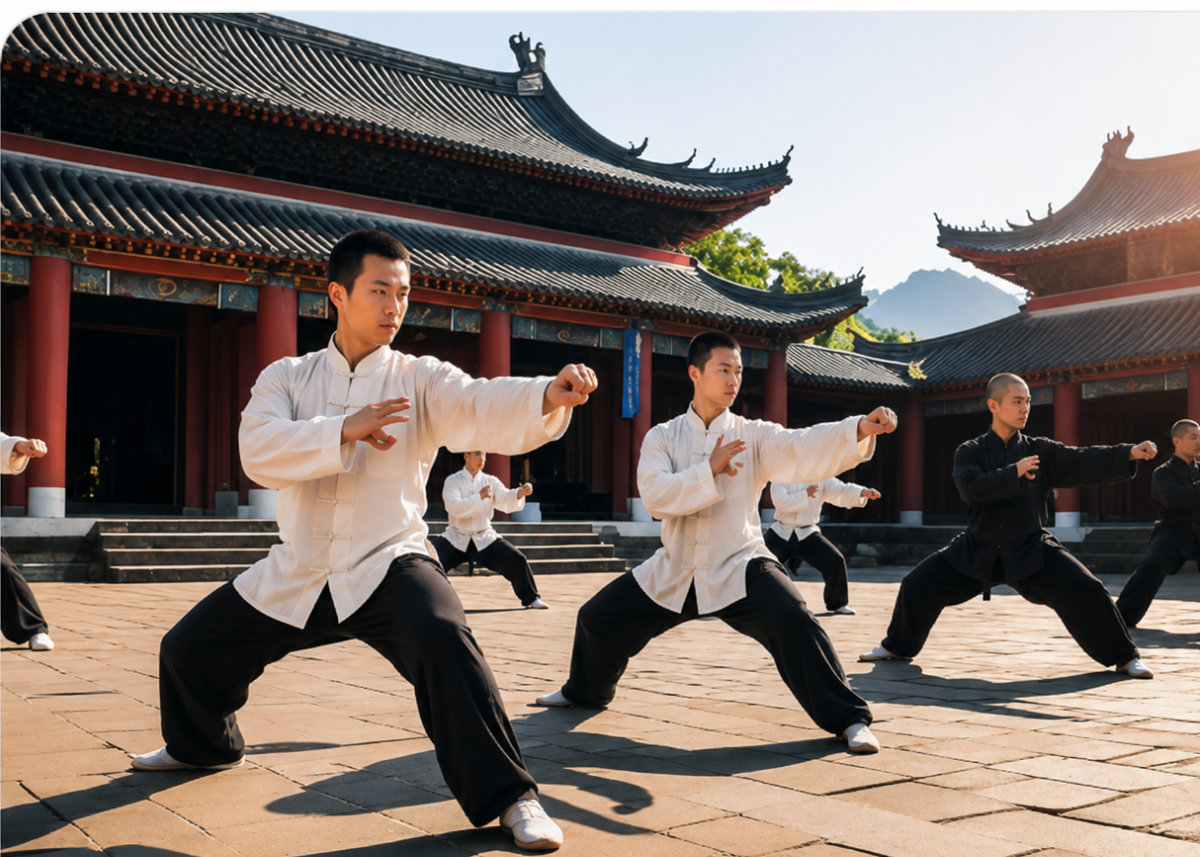
Every form ever created in the Chinese martial arts tradition is a carefully encoded system of technique, strategy, and structural principles, refined over generations and passed down because it works. What you’re learning when you train a form isn’t just a series of movements. You’re learning a body of accumulated wisdom about how to move, how to generate power, and how to respond to pressure.
What structure actually means
In Kung Fu, structure refers to the alignment of the body at any given moment, the relationship between your stance, your spine, your weight distribution, and your limbs. Good structure means that force can travel through the body efficiently, that you’re balanced and rooted rather than exposed, and that your techniques are expressing genuine power rather than just motion.
If you have poor structure, the movements might be in the right place, but the power leaks out at every joint. The balance is compromised, and under real pressure the whole thing tends to collapse. This is why two practitioners can perform what appears to be the same technique, and the results can be completely different. The difference lives in the structure underneath.
Forms training is how structure gets into the body. Not through thinking about it, but through repetition. Every time you move through a sequence with correct alignment, you’re reinforcing a physical pattern. Over hundreds and thousands of repetitions, that pattern becomes ingrained, it’s something you simply do.
Why forms are not just choreography
One of the most common misunderstandings about forms is that they’re a kind of performance, a sequence you memorise and reproduce. This view tends to produce practitioners who know the shape of the art but not the substance of it.
Every movement in a traditional Kung Fu form has martial intent and application. The angle of a block is designed to redirect specific attacks. The footwork encodes evasion and positioning strategy. The transitions between techniques contain their own tactical logic. When you understand what each movement is actually doing, the form comes alive in a completely different way. You’re not moving through choreography at all, you’re rehearsing solutions.
This is one of the reasons the online courses taught by Sifu George Michielsen include application breakdowns alongside the form instruction itself. Learning what a movement does changes how your body performs it. The intention is visible in the technique, and intention is a significant part of what makes a technique effective.
Structure under pressure
The real test of form training is what happens when things get hard. In sparring, under stress, in any situation where the thinking mind doesn’t have time to catch up, your body will do what it has practised most. This is why traditional training places such a high value on correct structure from the very beginning.
A bad habit trained a thousand times is a thousand times harder to undo. A good structure trained a thousand times becomes automatic, available precisely when you need it most. The forms are the vehicle through which correct structure gets that kind of deep repetition in a safe, focused environment.
The deeper purpose
Beyond the martial application, forms training develops something harder to name but just as valuable. The quality of attention required to move through a form with genuine precision, the focus it takes to bring correct structure, breath, and intention together in every movement, is a kind of moving meditation. Practitioners who train seriously often describe a particular clarity of mind that comes from good forms practice, a settling of the nervous system and a sharpness of presence that carries into everyday life.
The masters who built these arts understood that the external and the internal were inseparable. Training the body well trains the mind. Training the mind improves the body. Forms are where those two things meet.
This is a practice worth taking seriously, from your very first sequence to the thousandth repetition of a form you’ve known for years. It keeps giving the longer you stay with it.
If you’re ready to learn forms rooted in authentic Shaolin lineage, taught with both the ‘how’ and the ‘why’ from the ground up, the online courses at the Chinese Kung Fu and Tai Chi Academy are a wonderful place to begin. Explore the courses here.
