Walk into a traditional kung fu school and one of the first things you notice is the weapons rack. Staffs, sabres, spears, butterfly knives, broad swords: lined up along the wall, silent and waiting. To someone new, they can look like a decorative nod to history. But in a school that takes its tradition seriously, those weapons reach much deeper than most people expect.
Traditional kung fu weapons training is not about learning to fight with a sword in the modern world. It is about what the weapon reveals in you, and what it builds in you, that empty-hand training alone cannot quite reach.
What a weapon shows you about yourself
When a student picks up a staff for the first time, their foundation is immediately visible. Every place where power leaks out, and every moment where balance is slightly off or timing is fractionally late – the staff amplifies all of it. You cannot fake a good staff form. The weapon is an extension of the body, and the body doesn’t lie when it is holding something that demands full structural commitment from the ground up.
This is precisely why traditional systems introduce weapons at a certain stage of training rather than at the beginning. A student needs enough foundation in their stances, footwork, and power generation to have something for the weapon to test. Once they do, the weapon becomes one of the most honest teachers in the school. The staff, known in many traditions as the father of all weapons, shows you where your energy leaks and where your structure holds. It teaches economy of movement in a way that is difficult to replicate with empty hands, because wastefulness with a long weapon is immediately obvious, both to the practitioner and to anyone watching.
The Northern sabre and what it brought to Buk Sing
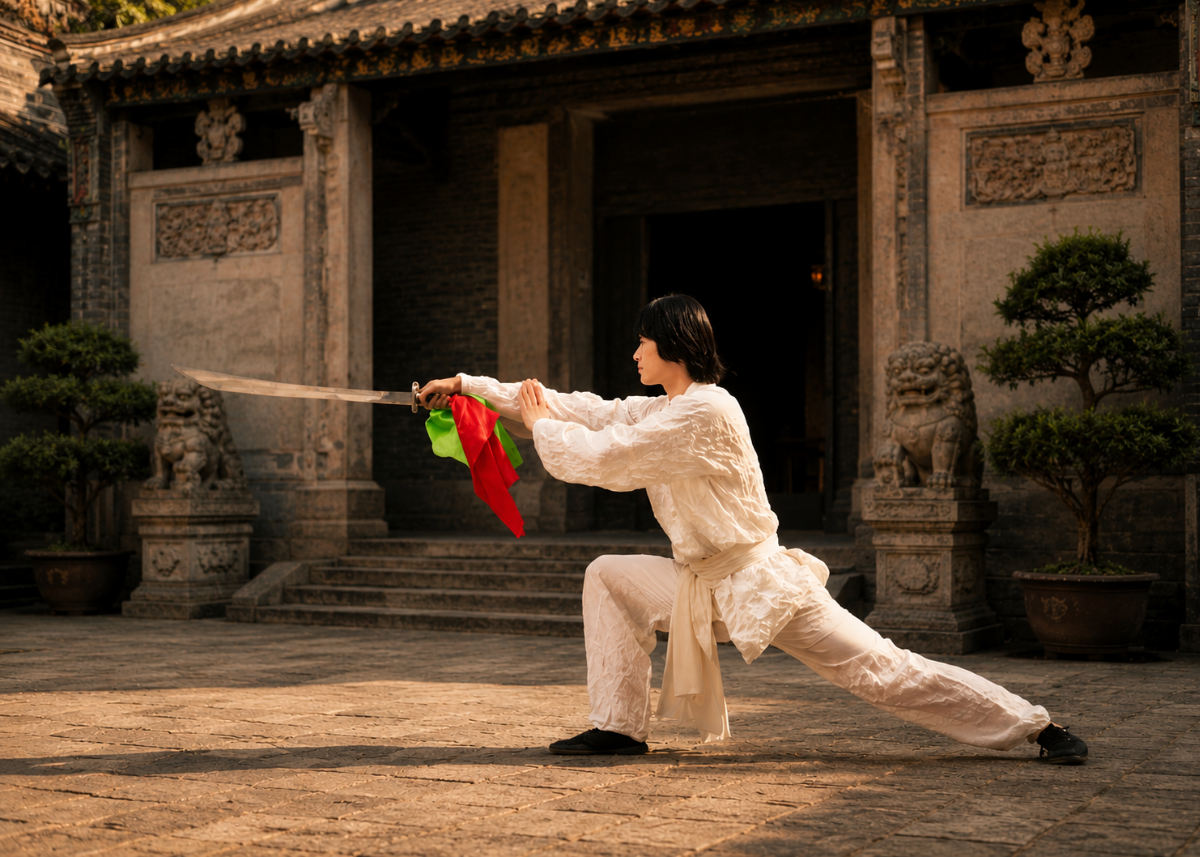
In the Buk Sing Choy Lay Fut system, the role of weapons in transmitting knowledge carries its own remarkable history. When Grandmaster Tarm Sarm exchanged students with Ku Yu Cheung, the great Northern Shaolin master, one of the things that passed between their schools was the Ma Moon Do, the Horse Gate Broadsword form. Ku Yu Cheung was already legendary for his physical power and his mastery of Northern Shaolin, and his approach to the sabre embodied everything that made the Northern system distinctive: wide sweeping arcs, spinning footwork, long-range extension, and a quality of movement that demands the practitioner use every part of their body as a unified structure.
Tarm Sarm recognised what the Northern sabre offered and incorporated it into the Buk Sing system. Students who reach that stage find themselves working with a form that calls on their full foundation, testing range, coordination, directional change, and explosive power. The weapon is not an add-on. It is a continuation of the same education, taken into new territory.
Kong Hing, one of the most revered masters in the Buk Sing lineage, was famous for his double broad swords. Those who watched him demonstrate described a quality of movement that was almost impossible to separate from the weapons themselves. He was seen as one with his blades, which is exactly the relationship that traditional weapons training aims to build.
The staff and its particular demands
Of all the traditional weapons in Chinese martial arts, the staff holds a special place. Historically it guarded temples and protected travellers. Practically, it teaches coordination, range management, and whole-body power generation in a way that transfers directly back into empty-hand training. A practitioner who truly understands how to generate force through the full length of a staff, from the ground through the hips, through the waist and shoulders and out to the tip, understands something about body mechanics that improves everything they do with their hands.
The Choy Gar Gwan, the Choy Family Staff form in the Buk Sing curriculum, trains all of this through sweeping strikes, spinning transitions, and angled footwork that place real demands on the practitioner’s structure and timing. Students who work through this form consistently report that their empty-hand practice feels different afterwards, more grounded, more connected, more clear about where force actually comes from. That is the weapon doing its job.
Why weapons carry lineage
Weapons forms are some of the most carefully preserved elements of any traditional system. They are harder to modify on a whim than hand forms, more specific in their technical demands, and often linked directly to historical figures who shaped the lineage.
When a student trains the Ma Moon Do, they are training something that passed through Ku Yu Cheung’s hands, then through Tarm Sarm’s vision of how Northern and Southern principles could be combined, then through Kong On and Kong Hing and the Lacey brothers and eventually to the school as it exists today.
Shane Lacey, son of Grandmaster Lay Wing Sung and one of the most decorated martial artists in the Buk Sing lineage, won five consecutive Four Star Grand Champion titles at the International Chinese Martial Arts Championships, taking all four divisions including the long and short weapon categories. His mastery of weapons was not separate from his overall martial skill. It was an expression of it, the same foundation applied through a different medium.
What weapons training builds in a practitioner
Beyond the technical, traditional kung fu weapons training builds something that is harder to name but that experienced practitioners recognise immediately: a quality of attention and commitment that transfers into everything else. You can’t be half-present when you’re working with a traditional weapon. The form demands your full focus, every time, because anything less produces movement that is immediately unsatisfying and technically wrong.
That quality of full presence, cultivated with a staff or a sabre, makes its way back into how a student trains their empty-hand forms, how they spar, how they carry themselves in the school. A practitioner who trains weapons seriously tends to train everything more seriously, because the weapon has raised their standard for what committed practice actually feels like.
This is why the weapons rack at any traditional school is not a decoration. Every weapon on that rack represents a body of knowledge, a technical tradition, and a direct link to the masters who developed and preserved these arts over generations. When a student finally picks one up and begins to learn, they are not adding something extra to their training. They are stepping into one of the oldest and most honest classrooms in the system.
